
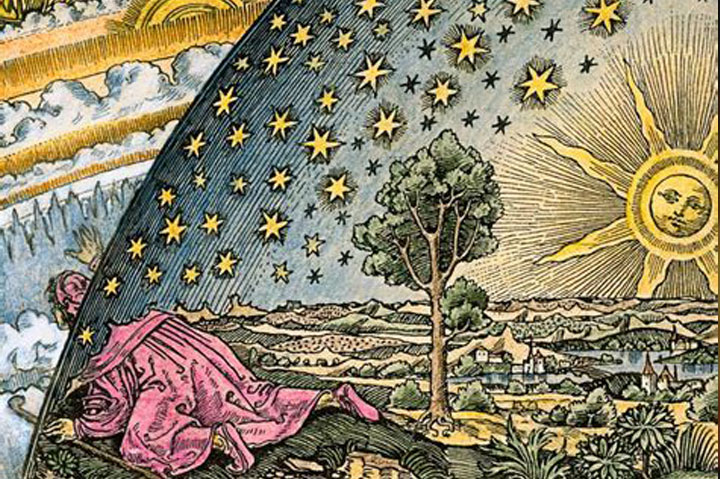
There’s a famous illustration by Camille Flammarion showing a traveller kneeling at the edge of the world, lifting the sky like a curtain to glimpse the vast cosmos beyond. It’s often seen as a metaphor for the human impulse to go beyond what’s known, to question inherited ideas and step into a larger understanding.
This image has been quietly echoing in me lately, because it mirrors something that happens to anyone who walks a sincere path in life. There comes a moment when the frameworks that once gave us meaning (the maps, theories, and systems we so relied upon) begin to feel too small. We sense that to keep advancing, we must outgrow ourselves.
The Gift and the Limitation of Every Framework
In the early 2000s, my life was deeply woven with music, having been active in the music industry for almost 10 years. Around 2002, I encountered the very first whispers of what would later become the “432 Hz movement”. At the time, I received it as a revelation: the idea that a simple change in the tuning of instruments could shift the effects of music in a positive way. It almost felt like a hidden code had been revealed.
That discovery changed the trajectory of my musical life. I pivoted much of my work around this idea, exploring its implications and, together with others, helping to spread it into the wider world. It was an exciting experience: a sense of re-enchantment through sound, of reclaiming something that had been lost.
Yet, as years passed, I began to see that even the most beautiful idea can become a boundary. The deeper I went into the practice of sound, the more I realised that 432 Hz, like any frequency, any system, any formula, is only relatively important.
The real transformation does not come from the number on a tuner, but from the quality of consciousness we bring to the sound. Ideas like this can open a door, but it is presence that walks us through it. To stay alive in our practice, we have to keep breaking through the firmaments of our own ideas.
The Alchemy of Unlearning
Sound therapy, when approached as a living path, constantly invites this kind of unlearning. Initially, we seek resonance, particularly between ideas. But eventually we are drawn toward coherence, an inner harmony that allows for paradox and mystery.
Outgrowing oneself means letting go of the comfort of fixed meanings. It means allowing our instruments, our voice, and even our identity as “practitioners” to dissolve and reform in new ways. This is the alchemical process of solve et coagula: dissolve and re-create.
Each of us begins our journey with certain tools and, more importantly, with a map that allows us to even start the journey. Scales, chakra systems, frequencies… they are all valuable entry points. But sound itself is not confined by any system. It moves through them like wind through open strings.
If we come to the point where we stop trying to use sound and start to listen to it, we discover that sound is not an object we apply to others but a relationship that transforms us both. In that moment, the practice ceases to be something we do and becomes something we are.
The Song of Becoming
Growth in sound work, as in life, is cyclical, like octaves unfolding upwards. Every time we think we have arrived, another horizon appears. What seemed like mastery turns into a new beginning. The frameworks we once clung to reveal themselves as stepping stones across a wide field.
To outgrow oneself is not to reject what came before but to see it from a new perspective; to honour it as a necessary phase that brought us here. Just as I once devoted myself to the 432 Hz idea and later moved beyond it, so too must we all allow our beliefs, methods, and identities to evolve.
True maturity in sound therapy is not about collecting techniques or defending opinions. It’s about refining our capacity to listen… to ourselves, to others, to life. Sound becomes a mirror for where we are in our evolution, reflecting where we are open and where we are still clinging.
Outgrowing oneself, then, is not an end but part of a rhythm. It’s the natural music of growth. Each time we lift the curtain of the familiar, we glimpse a wider cosmos, and the sound we hear from the other side is always the same: the song of becoming.
Check our other articles
The Power of Sound in Sacred Texts
Throughout human history, sound has occupied a significant place in spiritual and religious traditions. Sacred texts contain numerous passages in which sound appears as much more than a means of communication or musical expression. The spoken word creates. A voice...

Sound Therapy and Sleep
Sleep is one of those things that tends to reveal a great deal about the state of a person's nervous system. When the system is genuinely at ease, sleep arrives without much effort. When it is under chronic strain, a quiet bedroom can become an unexpectedly difficult...

432 Hz – Does Frequency Have a Meaning?
The discussion around tuning music to 432 Hz continues to evoke strong responses. For some, it represents a return to natural harmony. By others, it is dismissed as pseudoscience wrapped in attractive language. Between these positions lies a more useful question: what...