

Why the Vagus Nerve Matters
In my 2019 article “Sound Therapy and the Vagus Nerve“, I introduced the relevance of the vagus nerve in sound-based therapy.
The vagus nerve, the great “wanderer” of the nervous system, weaves its way through your body, linking your brain to your heart, lungs, and gut. Besides regulating autonomous functions, It sets the tone for how safe, calm, or stressed you feel in daily life.
When vagal tone is strong, your body shifts easily into rest and recovery. Your heart rate slows, digestion flows smoothly, and you bounce back from stress with more resilience. When it is weak, stress lingers, sleep suffers, and inflammation rises [1].
Measuring vagal tone has become a field of its own, with heart rate variability (HRV) serving as the gold-standard marker [1]. But more importantly, the vagus nerve offers us a gateway: if we can find ways to stimulate it naturally, we gain access to one of the body’s most powerful healing switches.
And this is where sound comes in.
Updates based on recent research
It might sound almost poetic, but science is catching up to what many ancient traditions have long known: sound can speak directly to the nervous system.
- In 2023, researchers confirmed that humming, the simplest of sounds, measurably increases HRV, signalling a rise in parasympathetic (vagal) activity [2].
- Vibroacoustic Sound Massage, which bathes the body in low-frequency vibration, was shown in 2024 to reduce stress and increase vagal markers across different groups of people [3].
- A specialised technique called HALF-MIS, combining deep vibration with music, helped people with depression achieve meaningful improvements in mood in a pilot clinical trial [4].
- Gentle vibration of the ear, where the vagus nerve has a branch, has been shown to modulate brain networks tied to emotion [5], while even subtle air-pressure stimulation at the cymba concha (a part of the outer ear involved in directing the sound towards the ear canal) increased HRV and shifted the body into parasympathetic balance [6].
- Fascinatingly, time of day matters: morning sessions of vagus stimulation produced stronger responses than evening ones [7].
These findings paint a picture of a nervous system that listens to vibration, tone, and rhythm.
Techniques & Modalities in Sound Therapy
Sound therapy offers a palette of methods for vagus nerve stimulation. Some are as simple as using your voice; others involve instruments or specialised devices.
-
Humming & Chanting: The vibration you feel in your skull and chest can be experienced as pleasant and it stimulates the vagus nerve while the prolonged exhalation calms the breath [2].
-
Humming, Toning & Chanting: Sustaining vowels or resonant tones can stimulate the vagus nerve while the prolonged exhalation calms the breath [2]. The result is an entrainment of the body into coherence.
-
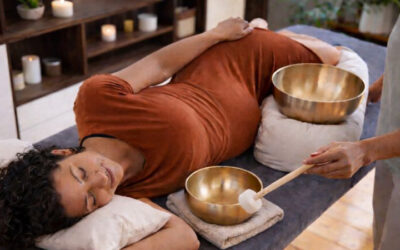
Singing Bowls & Gongs: Their low, enveloping frequencies create a cocoon of resonance that often brings people into deep parasympathetic states.
-
Tuning Forks: Applied to the sternum, sacrum and acupuncture points, they deliver direct vibrational input to the body.
-
Vibroacoustic Therapy: Chairs, cushions, or beds that transmit low-frequency sound into the body have been clinically shown to reduce stress [3].
-
Therapeutic Music Listening: Carefully composed soundscapes or pieces with slow rhythms and warm harmonies can encourage breathing to slow and heart rhythms to steady.
In each of these, sound is heard but most importantly felt… a dialogue between vibration and the nervous system.
Protocols for Daily Practice
The beauty of sound-based vagus stimulation is that you don’t need expensive tools to begin. Your own voice is already one of the most potent instruments.
-
Morning Humming (5 minutes): Sit comfortably, close your eyes, and let each exhale turn into a soft hum. Feel the vibration across your face and chest. This simple practice primes your system for resilience throughout the day [2].
-
Midday Reset with Tuning Forks (3–5 minutes): If you have a tuning fork (a weighted, 128 Hz fork is particularly common), strike it and rest it gently on your sternum. Allow the resonance to spread through your ribcage.
-
Evening Vocal Toning (10 minutes): Use deep vowel sounds like “Ooo” or “Ahh,” letting your voice drop into lower frequencies. This helps release tension and prepare for restful sleep.
-
Weekly Sound Bath: Whether with bowls, gongs, or curated recordings, immerse yourself in vibration. Longer sessions create the conditions for profound nervous system recalibration [3].
-
Ear Stimulation Practice: If you have access to vibrotactile or airflow devices designed for auricular stimulation, short sessions in the morning may support HRV more effectively [6][7].
These practices are gentle but cumulative: regularity matters more than intensity. Over time, they condition your vagal pathways, like tuning the strings of an instrument.
Tools & Resources
-
Voice: The most accessible and personal tool you have.
-
Tuning Forks: Portable and effective for self-practice.
-
Singing Bowls & Gongs: Create immersive resonance for group or individual sessions.
-
Vibroacoustic Devices: From chairs to cushions, these offer clinical-level vibration delivery [3].
-
Apps & Recordings: Look for those featuring uncompressed low frequencies or guided humming/toning practices.
-
Emerging Ear Stimulation Tools: Devices designed to vibrate the cymba concha have been shown to increase the “relaxation response” [6].
Ultimately, the tool is less important than the intention and consistency. When approached with presence, even a few minutes of sound can shift the inner landscape.
References
- Gidron, Y. et al. (2025). Vagal tone as a psychophysiological marker of health: recent updates. Frontiers in Psychology. https://doi.org/10.3389/fpsyg.2025.1639866
- Vempati, R. et al. (2023). Humming (Simple Bhramari Pranayama) as a Stress Buster. Indian Journal of Physiology and Pharmacology. https://pmc.ncbi.nlm.nih.gov/articles/PMC10182780/
- Rüütel, E. et al. (2024). Effects of Vibroacoustic Sound Massage on Physiological Stress and Heart Rate Variability. Sensors, 24(18), 5924. https://doi.org/10.3390/s24185924
- Aksnes, A.K. et al. (2019). High Amplitude Low Frequency Music Impulse Stimulation (HALF-MIS) as a treatment for depression: A pilot study. Brain and Behavior, 9(10), e01335. https://pmc.ncbi.nlm.nih.gov/articles/PMC6790306/
- Wilke, M. et al. (2024). Auricular vibrotactile vagus nerve stimulation modulates limbic connectivity. Frontiers in Neuroscience. PMID: 40440290
- Kim, J. et al. (2022). Air pressure stimulation of the cymba concha increases parasympathetic activity in healthy adults. Annals of Rehabilitation Medicine, 46(2), 79–90. https://www.e-arm.org/journal/view.php?number=4289
- Leuenberger, S. et al. (2022). Circadian effects of transcutaneous auricular vagus nerve stimulation on autonomic function. PLoS ONE, 17(11): e0277090. https://doi.org/10.1371/journal.pone.0277090
- Shukla, A. et al. (2025). Slow-paced breathing with humming enhances vagal activity compared to slow breathing alone. Physiology & Behavior, 274, 113445. https://doi.org/10.1016/j.physbeh.2025.113445
Check our other articles
SonoBirth: Supporting Regulation and Connection in Pregnancy and Birth
How Sound Becomes a Practical Ally in Pregnancy and Birth In my previous article, Sound Therapy in the Field of Pregnancy and Birth, I spoke about the profound role sound plays in early life. But once people understand its importance, the next question naturally...

Outgrowing Oneself
There’s a famous illustration by Camille Flammarion showing a traveller kneeling at the edge of the world, lifting the sky like a curtain to glimpse the vast cosmos beyond. It’s often seen as a metaphor for the human impulse to go beyond what’s known, to question...

When Sound Makes Light: Sonoluminescence at the Edge of Physics and Mystery
If you send a loud enough tone into a liquid, tiny gas bubbles can implode so violently that they flash with light. This is called sonoluminescence. In its cleanest laboratory form, a single micron-scale bubble sits in a standing acoustic wave and emits a...